
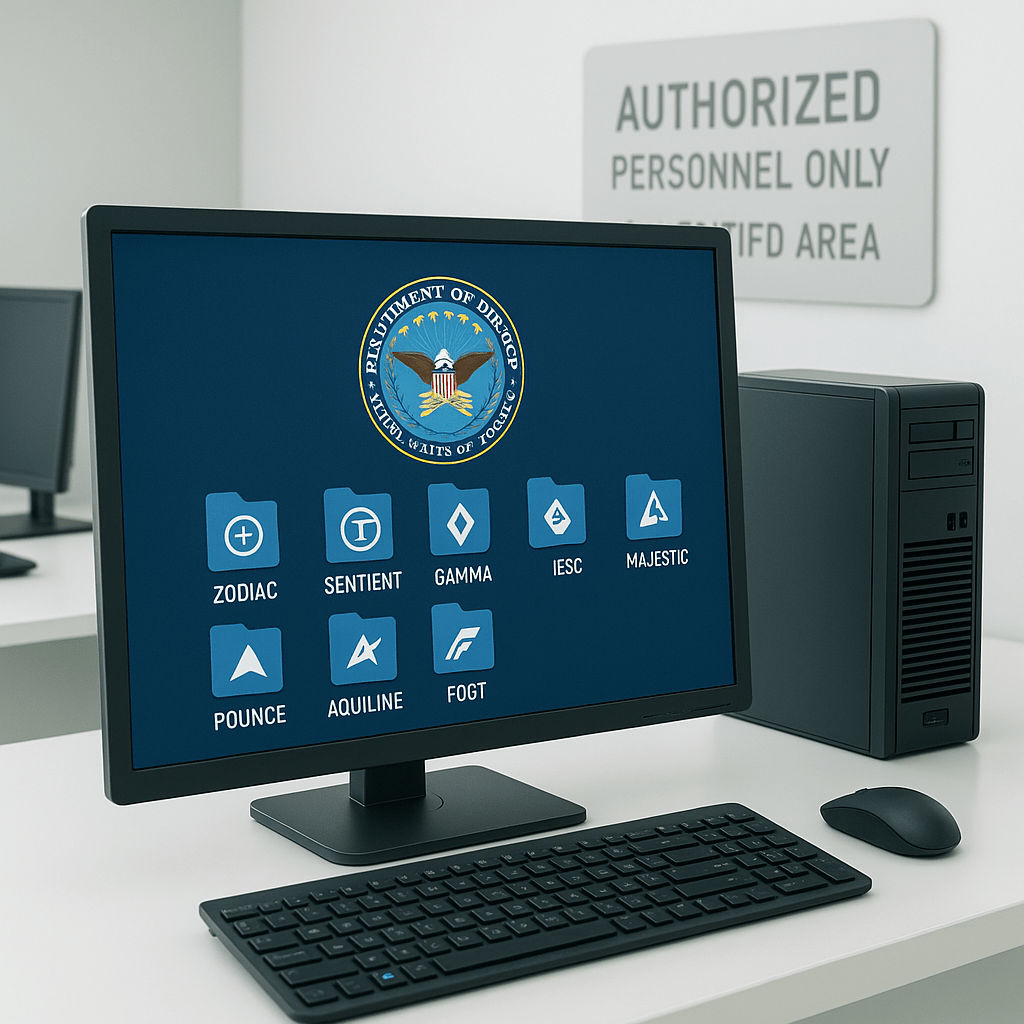
U.S. government programs, especially those under Title 10 (DoD) and Title 50 (Intelligence) authorities, are frequently shielded behind codenames and codewords.
Codenames: Obscuring Intent
Codenames often serve to obscure a program’s purpose and can be arbitrarily chosen. Their function is not classification per se, but camouflage—designed to mislead casual observers or even internal actors without need-to-know access.
Examples of real historical codenames include:
- MKULTRA – A CIA program exploring mind control, drug-induced behavior modification, and interrogation techniques, often without informed consent
- ARTICHOKE – A precursor to MKULTRA focused on hypnosis, forced addiction, and “special interrogation”
- COINTELPRO – FBI counterintelligence operations against civil rights leaders, political dissidents, and activist groups
- CHAOS – CIA domestic surveillance operation targeting anti-war activists (a clear Title 50 overreach into domestic jurisdiction)
- STARGATE – DIA/CIA remote viewing project exploring psychic phenomena and extrasensory perception for intelligence use
- ECLIPSE – Believed to be a family of Special Access Programs (SAPs) involving black aerospace projects
In these cases, the codename revealed nothing about the underlying objectives, thereby serving to keep scrutiny and FOIA exposure minimal.
Codewords: Compartmentalized Access Control
Codewords operate under a stricter regime—these are specific identifiers for compartments within Sensitive Compartmented Information (SCI). A single program might be protected by several codewords to prevent lateral movement by insiders and to restrict access to the most sensitive methods, sources, or technical capabilities.
Examples:
- GAMMA – Signals Intelligence (SIGINT) compartment for high-grade collection, often from diplomatic or military sources
- HUMINT Control System (HCS) – Codeword used for human intelligence sources and methods
- TALENT-KEYHOLE (TK) – Designator for satellite-derived imagery intelligence
- UMBRA – Historic compartment associated with SIGINT, especially NSA-level collection
In Title 50 environments, these are used to layer secrecy within secrecy—particularly in “black” or “deep black” SAPs, USAPs and WUSAPs (Special Access Programs).
Codenames and Codewords Tied to UAP/NHI Programs
Over the decades, numerous codenames and codewords have been rumored, leaked, or even semi-confirmed in connection with UAPs and alleged non-human intelligence (NHI) encounters. While some are speculative, their repetition across whistleblower testimony, FOIA releases, and investigative journalism makes them worth noting.
- ZODIAC – Mentioned in the alleged Wilson-Davis notes, possibly referring to a UAP reverse-engineering SAP
- MOONDUST – Real program involving recovery of space objects, sometimes speculated to have included downed anomalous craft
- SENTIENT – Allegedly a predictive battlefield awareness AI system under DIA/NRO; whistleblower Matthew Brown claims it was partially aware of anomalous craft and used to obfuscate intelligence pathways
- IMMACULATE CONSTELLATION – Brown also claimed this was a codeword or system used to sanitize or intercept UAP-related intelligence traffic before reaching the wider intelligence community


 UAP News Desk
What are your thoughts?