
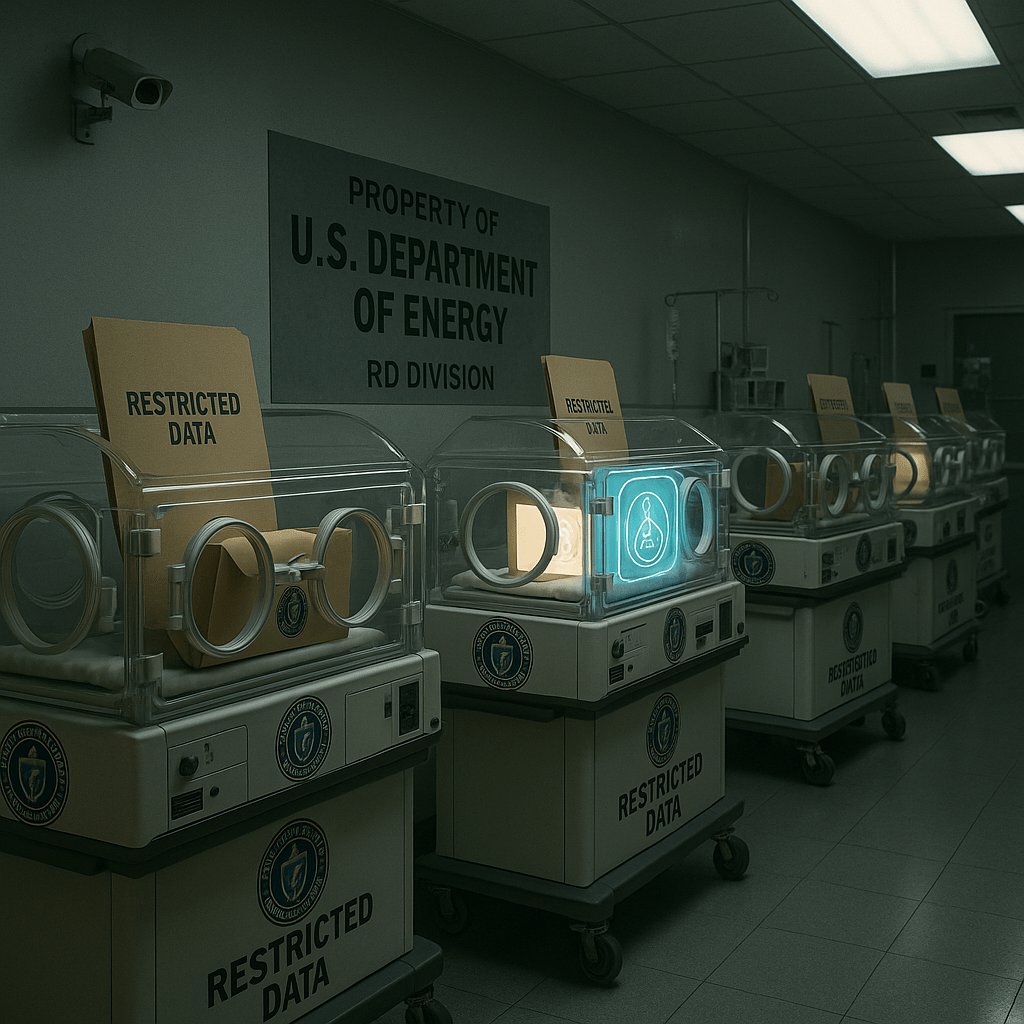
“Born secret” is a legal concept established under the Atomic Energy Act of 1954, which mandates that certain categories of nuclear-related information are automatically classified as Restricted Data (RD) from the moment of their creation, regardless of whether they have been officially marked or reviewed. This means that such information is considered classified at inception, even if it originates outside the government or is independently discovered.
The “born secret” principle can be used to:
- Block publication of information
- Block patents
- Block or control academic research on RD
Real-World Statistics and Examples
The “born secret” doctrine has had measurable impacts on innovation and patent activity:
- Over 5,000 patent applications have been reviewed by the Department of Energy (DOE) and its predecessors (AEC, ERDA) under national security scrutiny for possible classification, according to GAO and DOE records
- As of a 2002 DOE Inspector General report, more than 300 patents were formally withheld or delayed due to their classification as containing Restricted Data (RD) or Formerly Restricted Data (FRD)
- One of the best-known examples is the 1979 case of John Aristotle Phillips, a Princeton student who designed a workable atomic bomb as part of a term paper using open-source materials; the design was immediately classified as RD and confiscated
- Hydrogen bomb-related patents have been automatically suppressed under “born secret” rules—even when filed by private individuals or international scientists who independently arrived at similar concepts
- During the Cold War, numerous laser-based uranium enrichment designs were blocked or diverted into classified programs; some university researchers were even served with DOE-issued Secrecy Orders
- Project Centurion and Project Gemini (not to be confused with NASA programs) reportedly involved fusion-related work that was heavily classified under born-secret rationales in the 1970s–80s
“Born secret” as it could relate to UAP
If UAP-related discoveries (e.g., anomalous isotopic ratios, gamma/neutron bursts, or exotic propulsion technologies) intersect with nuclear physics, they fall under immediate DOE jurisdiction—even without formal classification markings.
Therefore possible “born secret” information relating to UAPs might reasonably include:
- Energy generation or propulsion systems resembling fusion, antimatter, or zero-point energy concepts that could inform or enable next-generation nuclear weapon design
- Exotic materials (e.g., alleged metamaterials or isotopically anomalous alloys) that exhibit properties—such as radiation shielding, energy redirection, or nonlinear nuclear behavior—with direct or indirect implications for weapon physics
- Craft performance characteristics (e.g., acceleration profiles, radiation emissions, energy signatures) that suggest unknown mechanisms of energy release or containment relevant to advanced weapons design
- Engineering data from crash retrieval programs that, if reverse-engineered, could provide insight into weaponizable energy control systems, field manipulation, or directed energy
- Biological effects or trace signatures that indicate exotic radiation exposure, high-energy transients, or nuclear-like interactions inconsistent with known technology
- Sensor data or telemetry involving gamma, neutron, or EM bursts
- associated with UAP activity, particularly if detected by DOE-linked monitoring systems
In summary, “born secret” information is classified as being inherently dangerous at inception, not because of what it has done, but because of what it could do—because of its potential to alter power structures, trigger arms races, or collapse plausible deniability.
In the world of exotic technologies, reverse-engineered anomalies, or unorthodox physics, it may not matter how a discovery was made. If it even brushes against the architecture of nuclear relevance, it is classified at birth, and never allowed to grow in the open.



 UAP News Desk
What are your thoughts?